Simon Portbury on Visual Engineering, AI, and the Human Instinct to Make Art.
Simon Portbury calls his practice Visual Engineering: a research-led way of constructing images through creative direction, generative systems, compositing, retouching, motion, and post-production. In this interview, the Sydney-based artist explains why technology is never the idea, how AI helps him think further, and why intention and judgement remain central to authorship.
An Interview with Digital Original.
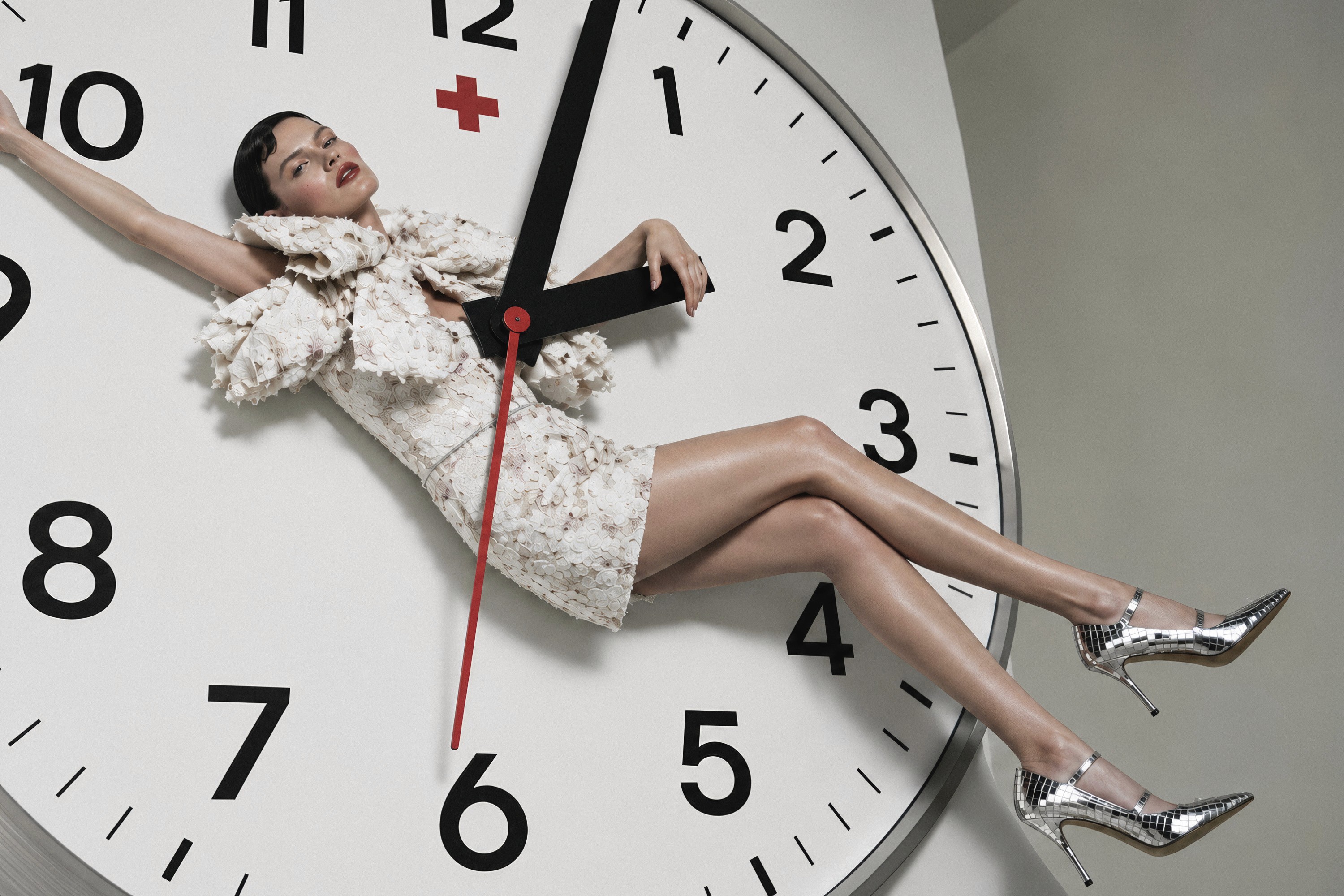
Simon Portbury’s images often appear to sit just inside the possible. A body seems to bend under an unfamiliar physical law. A transparent shoe becomes a vessel for flowers. Rare-earth minerals hover in tense arrangements with refined industrial forms. The light, materials, and proportions feel convincing, even when the scene could not exist outside the image.

Portbury calls this practice Visual Engineering. The term reflects a process shaped by more than two decades of creative direction and art direction, alongside photography, research, generative systems, compositing, retouching, motion, and post-production. AI is part of that process, but it is neither the starting point nor the subject of every work.
“The technology is not the idea. The tool gives you a capability. What matters is what you choose to make with it, why you’re making it, and the thinking and judgement you bring to the process.”
For Portbury, the work begins with curiosity. It develops through questions, research, experimentation, rejection, and revision. The result is a digital art practice concerned with material transformation, constructed realities, and the human impulse to make meaning from images.
Who is Simon Portbury?

Simon Portbury is a Sydney-based artist and creative director whose practice brings together art direction, photography, generative technology, retouching, and motion. He grew up in Melbourne in a world where the arts and humanities were part of everyday life. He studied music from a young age and developed an early appetite for independent film, magazines, design, and experimental music. He was equally interested in the mechanics behind culture: paper, printing, manufacturing, materials, and the way an idea changes as it moves from one form to another.
At 21, he moved to Sydney for his first advertising job. He began in agency media, then gravitated towards graphic design and art direction. Two years later, he started his own business.
An early international work trip revealed the direction of his attention. Portbury travelled through major fashion capitals with one of the first accessible digital cameras. When he returned to Australia, he discovered that most of his photographs were not of landmarks. They were of advertising, billboards, posters, and shop windows. He had also collected so many catalogues and international magazines that he had to mail kilos of printed matter home.
“Apparently I had travelled through some of the great cities of the world and documented the advertising, photographed the shop windows and mailed the printed matter home. That probably says quite a lot about me.”
Print had already taught him that the physical qualities of communication matter. His father ran a company in graphic arts and print publishing, so paper, texture, scale, and reproduction were never neutral surfaces. They were part of the idea. That same sensitivity now appears in Portbury’s digital art: the tools have changed, but his interest in how ideas become things has not.
What is Visual Engineering?
Portbury arrived at the term Visual Engineering because familiar categories no longer described his process accurately.
“I don’t consider it photography because it isn’t photography, and I’m not trying to position it as a replacement for photography either.”
His respect for photography is fundamental. He studied it for several years, including while living in London, and still commissions and works with traditional photography and videography. That training informs how he handles light, lenses, composition, depth, and material behaviour.
Visual Engineering uses that knowledge differently. Instead of recording a scene in front of a camera, Portbury constructs and directs the conditions of an image across generative systems, compositing, retouching, and post-production. Some scenes sit at the edge of physical possibility. Others deliberately cross it. A third group could be produced traditionally, but only at a scale or cost that would make sustained experimentation impractical.
The point is not simply to remove production constraints. It is to create room for discovery.
“I tend to begin with a question rather than an image. I research heavily, build the idea out, and then begin testing how it might take visual form.”
Unexpected results are not necessarily mistakes. They can redirect the work and reveal an idea that was unavailable at the outset. The process becomes an investigation rather than the execution of a fixed mental picture.
How research gives impossible images an internal logic
Portbury’s Terms of Contact / A Study in Rare Earth Minerals shows how research becomes visual structure.
The series began with a simple and uncomfortable realisation: rare-earth minerals underpin smartphones, electric motors, and many technologies associated with a cleaner energy future, yet they remain largely absent from visual culture. The materials are essential to contemporary life but almost invisible within it.
Portbury researched the raw forms, surface qualities, colours, and industrial outputs of specific minerals. From that work came the series’ central tension: geological matter against the refined object, the ancient against the engineered.

AI image generation entered as a directed creative tool within a larger process. Portbury developed precise frameworks for composition, colour relationships, and material pairings, then curated and refined the results. Early directions felt too decorative and too resolved. The breakthrough came when the materials began to feel as though they were negotiating with one another: precarious, unresolved, and resistant to easy beauty.
The final series occupies an ambiguous space between sculpture, still life, and material study. Terms of Contact 01 received the 2026 AIMA Award for Excellence in Conceptual & Fine Art.
This way of working explains why the word “engineering” matters. The image may be impossible, but it cannot be arbitrary. Light, surface, weight, and scale still have to belong to the same world.
How Simon Portbury uses AI as a thinking partner
Portbury began working with AI in late 2022. His involvement grew from curiosity rather than a plan to automate an established practice. Over time, different systems found different roles in the work.
He often starts with instinct: something catches his attention and opens a line of enquiry. He describes the sequence as “instinct, intention, then expression.” Before an image model becomes involved, he may use language models to discuss, test, challenge, and rebuild an idea.

That exchange is not frictionless. Portbury rejects suggestions, questions the system, and sometimes has to explain why a proposed direction is wrong. Articulating that disagreement can make his own position clearer. Sustained use has also produced a shared shorthand and rhythm, including humour.
“I’m not asking AI to think for me. I’m using it to make me think further.”
By the time the process reaches a generative image model, the idea may already have passed through several rounds of research and interrogation. The image model is where the conversation begins to take visual form. From there, Portbury generates, rejects, redirects, composites, retouches, edits, and sometimes moves into motion.
He resists treating AI as a single, uniform medium. A language model used to pressure-test an idea does something different from an image model used to construct a frame. Different systems enter at different stages for different reasons. The common factor is the artist.
“My instinct determines what catches my attention. My intention determines why I pursue it. My judgement determines what survives.”
How generative technology changed what he allows himself to imagine
Some of Portbury’s ideas existed long before the tools that could help him realise them. Notebooks accumulated with concepts that were physically impossible, prohibitively expensive, or simply difficult to pursue alongside a commercial practice.

Generative technology gave those ideas somewhere to go. It also changed the ideas themselves. When the first question is no longer “Can we physically make this?”, imagination begins to move differently. An artist can stop editing an idea according to location costs, fabrication, crew, or the laws of physics. The work can enter a more speculative space before practical decisions close it down.
That freedom is visible across IMPOSSIBLE, Flower Power, Heirloom, and Liquid State. Bodies, garments, flowers, metals, and familiar objects retain enough material credibility to invite belief, then behave in ways that resist it. The tension between reality and constructed fantasy is not a visual trick added at the end. It is the territory of the work.
Portbury estimates that 95 per cent of his experiments remain private. Accessibility makes more exploration possible, but it does not remove the need to select. What the public sees is the result of repeated decisions about what belongs, what communicates, and what deserves to survive.
What distinguishes an artwork from an impressive image?
Portbury’s answer is one word: intention. The ability to generate a polished image does not automatically create an artist. It does not prevent someone from becoming one either.
“Owning an expensive camera doesn’t make you a photographer. Access to a generative system doesn’t automatically make you an artist. But equally, using one doesn’t disqualify you from being one.”
He sees broader access to creative tools as a positive development. Photography, film, design, publishing, and music have all become more accessible through digital technology. People can now express ideas without first gaining access to expensive equipment, specialist training, or established networks.

That openness does not settle questions of authorship. It makes the artist’s choices more important. What is the work trying to say? Why does it exist? Which decisions carry the maker’s experience, curiosity, and point of view?
“Accessibility and authorship are different questions.”
He is equally direct about ethics. Plagiarism and theft remain plagiarism and theft, regardless of the technology involved. Inspiration, exposure, and cultural exchange have always shaped creative practice, but they are not the same as attempting to reproduce another artist’s work. His advice to artists entering generative practice is to bring their own questions to the tools. A technically impressive image may hold attention for a moment. A body of work needs somewhere deeper to go.
Is the artist becoming a director, editor, or engineer?
Generative systems have revived a familiar debate about the artist’s role. Is the artist still a maker, or have they become a director, editor, curator, or world-builder?
Portbury questions the premise. Artists have always commissioned, selected, directed, edited, and collaborated. Film makes this especially visible: a director can hold a precise vision while hundreds of specialists contribute to its form.
His own background in creative direction and art direction made him comfortable with this model long before generative technology. He knows the excitement of another person interpreting an idea and taking it somewhere better. He also knows the difficulty of watching an interpretation move away from its original intention.
Generative systems allow an artist to steer an idea across more of the process while retaining agency. That does not make human collaboration less valuable. It expands the number of positions an artist can occupy.
“You can make. Direct. Edit. Collaborate. Engineer. Or move between all of them. I rather like that freedom.”
What remains human in art made with AI?
Portbury does not pretend to know how autonomous AI systems will develop or whether they may eventually produce something we recognise as art without the kind of human input required today.
For now, his answer is grounded in practice. He brings instinct, intention, lived experience, and the original reason for making the work. The system responds. He decides how to respond in turn.
Art, in this view, remains a human impulse before it becomes an object or image. People make things to express what they experience, question, fear, desire, or imagine. AI may change the form of that expression. It does not erase the impulse behind it.
This is also why Portbury is wary of arguments that force generative work to seek validation from an earlier medium. He does not need Visual Engineering to be accepted as photography, or generative art to displace traditional art. New and established practices can develop alongside one another.
If AI renews interest in physical craft, analogue photography, and visible imperfection, he welcomes it. If it creates new forms of digital expression at the same time, he welcomes that too.
“There is room for both.”
Why a digital art practice needs a dedicated home
Portbury’s work rarely exists as a single image in isolation. A series develops around an idea, and its title, concept, and accompanying writing are part of the experience. That made context an important requirement for his online presentation.
He had already encountered Digital Original and followed several artists using it when the team approached him. Building his own site gave the personal practice a dedicated home and made the importance of that separation clearer.
“Digital Original gives me room to present those things together and, importantly, seems to value the thinking behind the work as much as the finished image.”
For Portbury, a dedicated artist website changes the pace of looking. Online audiences encounter a constant stream of images, often for only a few seconds. A professional website for digital artists can instead introduce the artist, keep a series together, document individual works, and give viewers time to understand the thinking behind them.

The context does not close interpretation down. It offers a public story while leaving room for the viewer’s own response. That is what Portbury values when he collects work himself: the chance to speak with the artist or understand what brought a particular piece into being. The explanation does not need to account for every element. It can simply give the encounter another dimension.
Readers can explore Simon Portbury’s artworks and biography on his Digital Original website.
Simon Portbury’s advice for artists using generative technology
The pace of change since 2022 makes prediction difficult. Image models improved, generative video arrived, multimodal systems developed, and previously separate tools began to connect. Portbury finds that every apparent boundary moves again.
After more than twenty years in creative practice, he is energised by having so much to learn. His advice is practical: experiment widely. Different image and video models interpret language in different ways and carry distinct visual tendencies. Even versions of the same model can respond differently to an idea. Understanding those differences is part of learning the medium.
“Test them. Break things. Make bad work. Read the release notes, however nerdy that sounds.”
Technique matters, but it is not enough. Portbury encourages artists to begin with something that can sustain investigation: a question, concept, experience, or idea. The work becomes more than the production of a striking image when the artist has somewhere meaningful to take it.
He remains open about the uncertainty. He does not know where generative technology will take art, culture, or his own practice next. For the moment, he is happy to keep finding out.
More pieces from Substack.
Sign up to subscribe.
Independent thinking on brand, creativity, and the ideas shaping both.
Connect.